
Partial dentures are removable replacement teeth designed to fill gaps when you still have some healthy natural teeth. They can restore chewing, support clearer speech, and help stabilise the bite, often with a more conservative approach than full dentures. In this guide, we explain the main types of partial dentures used in Australia, how upper partial dentures and lower partial dentures differ, what benefits and limitations to expect, and how we assess whether a partial denture is the right option for your mouth. We also cover typical costs, day to day care, and what to consider if you live around Warrawong, NSW and Wollongong, NSW.
Quick Answers
1) What are partial dentures?
Partial dentures are removable partial false teeth that replace one or several missing teeth while your remaining natural teeth stay in place. A partial denture sits on the gums and may use clasps or precision attachments for support. The goal is functional chewing, speech support, and improved stability.
2) Are upper partial dentures different from lower partial dentures?
Yes. Upper partial dentures often rely on a broader palate area for stability, while lower partial dentures usually have less surface area to grip and can feel more mobile at first. Tongue movement and saliva flow also affect comfort, so design and fit are especially important for lowers.
3) Who is a good candidate for a partial plate?
Many people with one or more missing teeth, stable gums, and enough strong natural teeth to help support a denture can be suitable. A partial plate can be helpful if you want a removable option, if implants are not suitable, or if you need a practical interim solution.
4) How much do partial dentures cost in Australia?
Costs vary depending on materials, complexity, and whether you need extra dental work first. Simple acrylic partial plate teeth are usually less expensive than metal framework designs. A tailored quote requires an exam because gum health, bite, and the number of teeth being replaced all change the plan.
5) Will a partial denture damage my remaining teeth?
A well designed partial denture should protect your bite and distribute forces, but it can contribute to wear or decay if plaque control is poor, clasps are not well maintained, or fit changes over time. Regular reviews and cleaning habits are key to keeping remaining teeth healthy.
What are partial dentures?
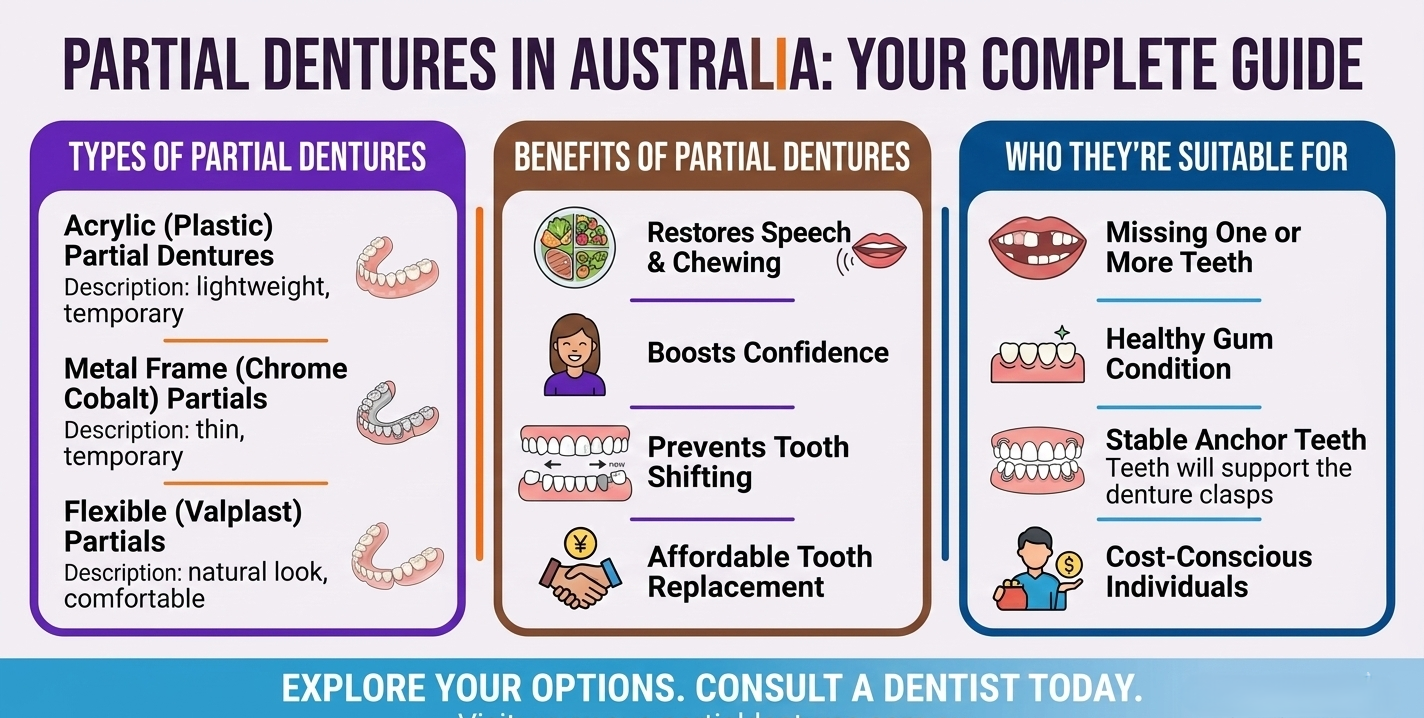
Partial dentures are removable dental appliances that replace missing teeth while keeping your existing teeth. They are sometimes called a partial denture, partial false teeth, or partial plate teeth. Most designs include replacement teeth set into a gum coloured base, with supports that help the denture stay secure.
A partial denture is made to:
- restore chewing efficiency for everyday foods
- support speech, especially if front teeth are missing
- help reduce unwanted tooth movement into gaps
- improve bite balance when several teeth are missing
Some people choose dentures and partials as a long term solution, while others use them as a stepping stone while planning other treatment.
Types of partial dentures used in Australia
Acrylic partial denture
An acrylic partial denture uses a pink acrylic base with denture teeth attached. It can be a practical option when multiple teeth are missing, when a short term solution is needed, or when budget is a major factor.
Common features
- usually quicker to make than more complex designs
- can be modified if more teeth are lost later
- may feel bulkier than other options
Typical uses
- interim tooth replacement after extractions
- replacing several missing back teeth
- as a temporary option while planning implants or bridges
To keep expectations realistic, acrylic partials can be less rigid and may move more during chewing, particularly for lower partial dentures.
Metal framework partial denture (cobalt chromium)
A metal framework partial denture uses a thin, strong metal structure with a smaller acrylic portion and denture teeth. Many patients find this style more stable and less bulky than an all acrylic design.
Why some patients prefer it
- thinner, often feels less “full” in the mouth
- generally more rigid and stable during chewing
- can distribute biting forces more predictably
A quick note on comfort
Even well made partials need an adjustment phase. If sore spots occur, we prefer to adjust the denture rather than you trying to “push through” discomfort.
For general background on dentures, you can also read the Australian government information on dentures.
Flexible partial denture (nylon based)
Flexible partial dentures use a bendable gum coloured material instead of rigid acrylic or metal. They may be considered when clasp appearance is a concern or when certain tooth shapes make retention challenging.
Potential advantages
- flexible clasping can look less noticeable
- may feel comfortable for some patients
Potential limitations
- not suitable for all bite patterns
- can be harder to adjust or reline in some cases
- may not provide the same long term stability as a rigid framework
Precision attachment partial denture
Some partial dentures use precision attachments rather than visible clasps. These designs typically require more planning and may involve crowns or other restorations on supporting teeth.
When it may be considered
- when aesthetics are a high priority
- when a clasp design is not ideal for retention
- when the bite forces need a more controlled design
Because attachments place specific demands on the supporting teeth, the suitability depends heavily on gum support, tooth strength, and bite.
Upper partial dentures vs lower partial dentures
Upper partial dentures
Upper partial dentures often have more surface area to spread pressure and may gain stability from the palate and ridge shape.
What patients commonly notice
- easier early stability compared with lowers
- possible “fuller” feel if the palate is covered
- initial changes in speech that settle with practice
Lower partial dentures
Lower partial dentures can be more challenging because the tongue, a smaller gum bearing area, and saliva can all influence movement.
Common experience
- a longer adaptation phase
- more need for fine tuning the bite and borders
- higher importance of correct clasping and support
Short adaptation checklist
- start with softer foods cut into small pieces
- chew evenly on both sides where possible
- practise reading aloud to speed up speech adaptation
- book adjustments early if you get sore spots
Benefits of partial dentures
Functional benefits
Partial dentures can improve how you manage everyday eating and speaking. When gaps are left unfilled, remaining teeth may drift, tilt, or over erupt, which can change your bite.
Common functional benefits
- better chewing for a wider range of foods
- improved bite stability
- support for pronunciation, especially for front tooth gaps
Oral health and structure benefits
Replacing missing teeth can support the overall balance of the mouth. While partial dentures do not stop all bone change, they can help manage some of the consequences of missing teeth.
Where they can help
- reducing food packing in gaps
- helping protect opposing teeth from uneven forces
- supporting facial appearance if several teeth are missing
Who should and should not consider partial dentures?
Situations where a partial denture may be suitable
Partial dentures can be appropriate when:
- you have one or more missing teeth with enough healthy teeth remaining for support
- you want a removable option
- you need an interim solution after extractions
- you are not ready for, or not suitable for, implants
Situations where we may recommend caution or alternatives
A partial denture might be challenging if:
- gum disease is active or poorly controlled
- supporting teeth are heavily decayed or mobile
- dry mouth makes retention and comfort difficult
- the bite forces are very heavy or you clench and grind
- the gap pattern makes a partial unstable
Key risks to understand
- plaque trapping around clasps can increase decay risk
- gum irritation if fit changes and is not adjusted
- fracture or wear over time
- bite imbalance if the design is not adequately supported
A helpful overview of denture care and wear considerations is also available via Better Health Channel’s denture information, which discusses practical day to day factors.
How dentists assess suitability for partial dentures
Step by step assessment process
When we assess partial dentures, we focus on stability, support, and long term tooth health. A typical process includes:
- Medical and dental history
We consider dry mouth risk, medications, reflux, diabetes control, and any previous denture experiences. - Gum and tooth health checks
We check for gum disease, tooth mobility, decay risk, and the condition of any existing crowns or fillings. - Bite assessment
We look at how your teeth meet, whether teeth have drifted, and whether there is space for partial plate teeth without overloading the gums or remaining teeth. - Imaging and planning
X rays help assess bone levels, tooth roots, and any hidden issues that affect clasping or support. - Design choice
We decide between acrylic, metal framework, flexible, or attachment options based on your bite, tooth positions, and functional needs.
What we prioritise in design
To make partial dentures safer and more predictable, we aim for:
- controlled force distribution
- stable support from teeth and gums
- a design that allows cleaning around supporting teeth
- a bite that does not tip the denture during chewing
Quick summary
If the supporting teeth and gums are stable and the bite can be balanced, partial dentures can be a reliable option. If not, we often need to treat gum disease, stabilise teeth, or consider alternatives first.
Cost of partial dentures in Australia
Why cost varies so much
There is no single “standard price” for partial dentures in Australia because cost depends on:
- number of teeth being replaced
- material choice (acrylic vs metal framework vs attachments)
- complexity of the bite and jaw relationship
- whether extractions, gum treatment, or fillings are needed first
- how many appointments and adjustments are required
Practical cost expectations
Rather than focusing on a single figure, it can help to think in tiers:
- Entry level acrylic partial denture: typically lower cost, often used as interim or simpler replacement
- Metal framework partial denture: typically higher cost due to lab work and design complexity
- Precision attachment partial denture: usually the highest complexity and cost due to additional restorative steps
What to ask when comparing quotes
- Does the quote include adjustments after delivery?
- Is a reline likely in the near future?
- Are you paying for a temporary partial, a long term partial, or both?
- What maintenance schedule is recommended?
Comparison of options
| Option | Typical comfort and stability | Longevity and maintenance | Invasiveness and suitability | Cost tendency in Australia |
| Acrylic partial denture | Can feel bulkier, may move more, especially lower partial dentures | May need more frequent relines, can be easier to modify | Least invasive, useful for interim or multiple missing teeth | Often lowest |
| Metal framework partial denture | Usually thinner and more stable | Often durable, still needs reviews and clasp checks | Conservative, needs healthy supporting teeth and good planning | Often mid to higher |
| Flexible partial denture | Can feel comfortable, appearance of clasps may be subtle | Adjustments can be limited, not ideal for every bite | Suitable in selected cases, not for all gap patterns | Variable |
| Precision attachment partial denture | Often secure and aesthetic | More components to maintain, needs careful follow up | More involved planning, may require crowns or restorations | Often highest |
What living with dentures and partials is really like
The first two weeks: common experiences
It is normal to notice:
- increased saliva initially
- mild speech changes
- pressure points as the mouth adapts
- chewing differences, especially with harder foods
How to make the transition smoother
- start with softer foods and progress gradually
- avoid very sticky foods early on
- clean after meals to reduce irritation
- do not use DIY filing or home adjustments
Cleaning and daily care for partial dentures
A consistent routine protects your gums and your remaining teeth.
Daily care essentials
- remove the partial denture at night unless advised otherwise
- brush natural teeth carefully around clasp areas
- clean the denture with a soft brush and suitable cleanser
- store it safely to avoid warping or breakage
- attend reviews so we can check fit and bite balance
Short summary
Most long term problems with partial dentures come from changes over time, not from day one. Regular checks help us keep the denture stable and protect supporting teeth.
Alternatives to partial dentures
Depending on your mouth and goals, alternatives may include:
- Dental bridge: fixed option that may involve reshaping adjacent teeth
- Dental implants: fixed option that replaces tooth roots, not always suitable for every patient
- No replacement: sometimes appropriate short term, but can lead to bite changes and drifting over time
When we discuss options, we focus on function, cleaning ability, risk to remaining teeth, and how stable we can make the bite over the long term.
What this means for patients in Warrawong, NSW and Wollongong, NSW
In our area, we commonly see patients balancing practical needs: eating comfortably, speaking confidently at work, and choosing solutions that can be maintained with realistic home care and review visits. If you have missing teeth, the most important next step is a proper assessment, because suitability depends on gum health, bite forces, and the strength of the remaining teeth. A well designed partial denture can be a sensible, conservative choice, but only when we can protect the teeth that are still doing the heavy lifting.
Conclusion
Partial dentures can restore function and confidence when you have missing teeth but still have healthy natural teeth remaining. The right choice depends on more than the number of gaps. Material, design, bite balance, and gum health all influence comfort and long term safety. If you are considering a partial denture, aim for a plan that protects supporting teeth, allows thorough cleaning, and includes follow up reviews. With careful assessment and maintenance, partial plate teeth can be a practical option for many Australians.
Speak With Our Team About Partial Dentures
If you are considering partial dentures to replace missing teeth, the most reliable next step is a professional assessment of your teeth, gums, and bite. At Bespoke Dental Studio, we help patients restore chewing function, improve comfort, and protect remaining teeth with carefully designed partial dentures.
Our dentists will assess the health of your gums and supporting teeth, explain the different partial denture materials and designs, and recommend a treatment plan that balances stability, hygiene, and long-term oral health.
Book a consultation with our team today to discuss partial dentures and find the option that works best for your smile and lifestyle.
You can book online at your preferred location or call our friendly team on +61 2 4274 1506.
Visit Bespoke Dental Studio
If you are considering partial dentures, our team at Bespoke Dental Studio can assess your teeth, gums, and bite to recommend the most suitable solution.
Book a consultation at your preferred clinic below or call +61 2 4274 1506.
Wollongong
68/143 Corrimal Street, Wollongong NSW
Book Online | Phone: +61 2 4274 1506
FAQs
1) How long do partial dentures last?
Many partial dentures last several years, but longevity depends on material, bite forces, and how much your gums and supporting teeth change. Metal framework partial dentures often last longer than acrylic designs. Regular reviews matter because small fit changes can cause irritation or stress on teeth if they are not adjusted early.
2) Do partial dentures feel natural?
They can feel natural once you adapt, but the first few weeks often involve an adjustment period. Upper partial dentures may feel more stable early on, while lower partial dentures can take longer due to tongue movement and a smaller support area. A well balanced bite and timely adjustments make a big difference.
3) Can I sleep with my partial denture in?
In many cases, we recommend removing partial dentures at night to let gums rest and reduce plaque build up. There are exceptions, such as short term instructions after certain procedures. If you sleep with dentures and partials regularly, it increases the importance of meticulous cleaning and scheduled reviews to protect gums and teeth.
4) Will a partial denture change how I speak?
It can temporarily. Many people notice lisping or difficulty with certain sounds for a few days to a couple of weeks. Reading aloud and practising common phrases helps. If speech issues persist, the denture may need adjustment for thickness, tongue space, or bite position, especially for upper partial dentures.
5) Are partial false teeth better than leaving the gap?
It depends on the gap and the bite. Replacing missing teeth can reduce drifting, food trapping, and bite instability, but a partial denture must be stable and cleanable to be beneficial. If the supporting teeth or gums are not healthy, we may recommend stabilising those first or considering other options.
6) Do partial dentures stop bone loss?
They do not fully prevent the natural bone changes that occur after tooth loss. However, they can support function and reduce some bite issues that develop when gaps are left. Implants provide root level stimulation, but they are not suitable for everyone. We focus on a plan that balances function, comfort, and oral health risks.
7) Can I eat normally with a partial denture?
Most people return to a wide diet, but it is best to progress gradually. Start with softer foods, cut food into smaller pieces, and chew evenly on both sides. Very hard or sticky foods can dislodge a new denture at first. If chewing remains difficult, we check the fit and bite balance.
8) How do I clean partial plate teeth properly?
Clean your partial denture daily with a soft brush and an appropriate denture cleanser, then rinse thoroughly. Brush and floss natural teeth carefully, especially around clasps where plaque can collect. Avoid abrasive toothpaste on the denture surface. Regular professional reviews help us check for calculus build up and fit changes.
9) What if my partial denture feels loose?
A loose partial denture can be caused by gum changes, wear, or clasp fatigue. Do not try to bend clasps at home. A review allows us to assess whether you need an adjustment, reline, repair, or a redesign. Leaving a loose denture can increase irritation and raise the risk of damage to supporting teeth.
10) Can partial dentures be made if I have gum disease?
They can be, but gum disease must be controlled first. Active gum disease can make supporting teeth less stable and increases the risk of further tooth loss. We usually prioritise cleaning, periodontal treatment, and home care stability before finalising a partial denture design. This protects your long term outcome and comfort.